
Cognitive and Neural Mechanisms of Emotion Regulation
Project title: Cognitive and Neural Mechanisms of Emotion Regulation: Strategies, Multimodal Effects, and Implications for Dysregulation in Depression
UL member institution carrying out the project: UL Faculty of Arts
Project code: J3-70147
Project duration: 1 March 2026 – 28 February 2029
Annual project volume: 1.66 FTE
Principal investigator: Grega Repovš
Discipline and field: ERC: LS5 – Neuroscience and Disorders of the Nervous System
Participating research organisations: University of Ljubljana, Faculty of Arts; University of Ljubljana, Faculty of Medicine; University Psychiatric Clinic Ljubljana
Project description
Emotions are a fundamental aspect of human experience, eliciting coordinated subjective, neural, and behavioral responses. Equally important is the ability to adaptively shape and regulate emotions, a process critical for maintaining quality of life and closely tied to psychopathology. Despite its significance, research on emotion regulation faces notable limitations. Many studies rely heavily on subjective measures, often neglecting multimodal assessments that capture changes across emotional responses during regulation. Furthermore, research frequently focuses on only one or two emotion regulation strategies, hindering direct comparisons of their effectiveness. Experimental designs often fail to disentangle the effect and effort associated with emotion regulation, leading to imprecise conclusions. Additionally, the role of individual differences in emotion regulation remains underexplored. These limitations collectively impede progress in understanding emotion regulation deficits, particularly in affective disorders such as major depressive disorder (MDD).
The proposed project is designed to address these research limitations. It is based on three key premises: (1) emotional responses may vary across subjective, neural, and behavioral components; (2) emotion regulation strategies differ in their effectiveness and the cognitive effort required for their implementation, with individual differences in emotional reactivity and cognitive control playing a critical role; and (3) these differences in emotional response and regulation are further altered in patients with Major Depressive Disorder (MDD). By employing a validated emotion regulation task within a full factorial design that enables separable estimation of regulation effect and effort, the project aims to provide a comprehensive understanding of emotion regulation processes across three complementary studies.
Project members
Department of Psychology, Faculty of Arts, University of Ljubljana – leads the study design and coordinates research efforts, develops novel methods and software tools, prepares experimental tasks and data collection software, oversees or performs data collection, conducts final data analyses, and leads manuscript preparation.
- Grega Repovš
- Anka Slana Ozimič
- Andraž Matkovič
- Aleksij Kraljič
- Nina Purg Suljič
- Lara Oblak
- Kristian Elersič
- Jana Verdnik
- Darja Kobal Grum
- Gaja Zager Kocjan
- Andreja Avsec
University Psychiatric Clinic Ljubljana – contributes expertise in psychiatry, particularly depression, and in first-person research; leads patient recruitment and participates in first-person interviews, behavioral and EEG data collection, and their preprocessing and analysis.
Faculty of Medicine, University of Ljubljana – provides access to the MRI scanner and contributes expertise in MRI acquisition and analysis.
Project phases and their implementation
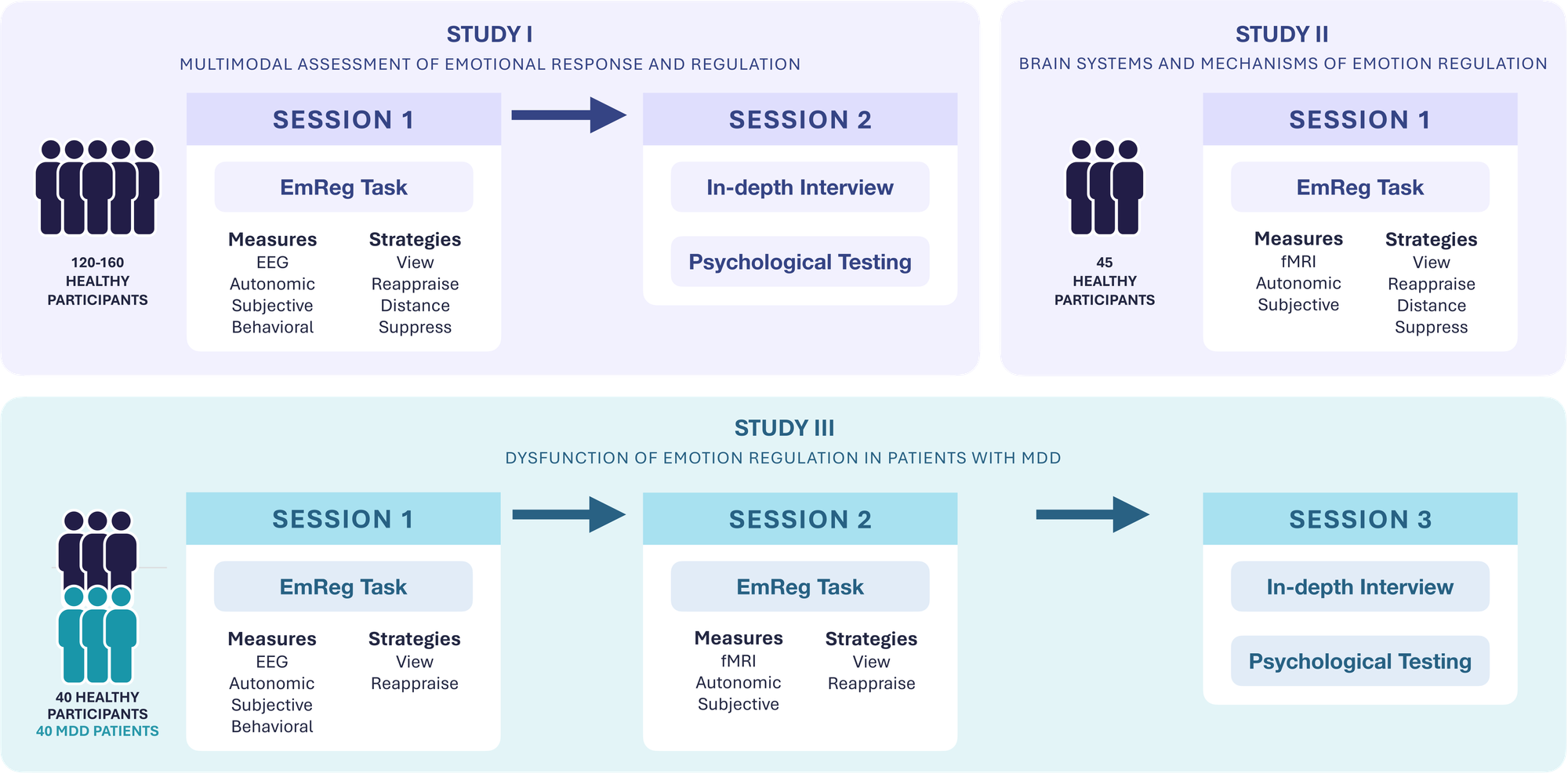
The project consists of three interconnected studies that together enable a comprehensive investigation of emotion regulation at the behavioral, physiological, and neural levels. Each study focuses on specific aspects of emotion regulation, using complementary methodologies to capture different components of the emotional response. The first study will use electroencephalography (EEG) together with psychophysiological and subjective measures to assess the effectiveness of different emotion regulation strategies. The second study will use functional magnetic resonance imaging (fMRI) to identify the brain regions and networks involved in emotion regulation. The third study will combine EEG and fMRI for a comprehensive assessment of emotion regulation in patients with depression.
The first study will utilize EEG, psychophysiological, and subjective measures to examine emotion regulation strategies, their effectiveness, and the effort required for their implementation. Specifically, this study aims to (a) obtain a comprehensive profile of emotional responses to emotionally salient stimuli, (b) evaluate how different emotion regulation strategies—distancing, reappraisal, and suppression—modify these responses, and (c) explore how these processes vary across individuals.
The second study will employ fMRI to investigate the brain systems and mechanisms underlying emotion regulation. We will collect fMRI data during the emotion regulation task and use activation, functional connectivity, and multivariate analyses to identify (a) brain regions and networks involved in emotional processing, (b) regions and networks supporting cognitive processes essential for emotion regulation, and (c) the interactions between these systems.
Finally, the third study will integrate EEG and fMRI to evaluate the regulation performance of patients with Major Depressive Disorder (MDD). This study will (a) assess differences in the effect and effort associated with reappraisal between MDD patients and normative controls, and (b) examine the underlying neural mechanisms driving these differences.
Bibliography
- Purg, N., Starc, M., Slana Ozimič, A., Kraljič, A., Matkovič, A., & Repovš, G. (2022). Neural evidence for different types of position coding strategies in spatial working memory. Frontiers in Human Neuroscience, 16, 821545. https://doi.org/10.3389/fnhum.2022.821545
- Oblak, A., Slana Ozimič, A., Repovš, G., & Kordeš, U. (2022). What individuals experience during visuo-spatial working memory task performance: An exploratory phenomenological study. Frontiers in Psychology, 13, 811712. https://doi.org/10.3389/fpsyg.2022.811712
- Hearne, L. J., Mill, R. D., Keane, B. P., Repovš, G., Anticevic, A., & Cole, M. W. (2021). Activity flow underlying abnormalities in brain activations and cognition in schizophrenia. Science Advances, 7(29), eabf2513. https://doi.org/10.1126/sciadv.abf2513
- Starc, M., Anticevic, A., & Repovš, G. (2017). Fine-grained versus categorical: Pupil size differentiates between strategies for spatial working memory performance. Psychophysiology, 54, 724–735. https://doi.org/10.1111/psyp.12828
- Dreo, J., Attia, D., Pirtošek, Z., & Repovš, G. (2017). The P3 cognitive ERP has at least some sensory modality-specific generators: Evidence from high-resolution EEG. Psychophysiology, 54(3), 416–428. https://doi.org/10.1111/psyp.12800
Research data management plan
The research data management plan (in Slovenian language) is available at this link.